“Man must know the principle of Creation: giving between each interchanging opposite half of each cycle for the purpose of repeating its giving. This is universal law and each individual must manifest this law.” – Walter Russell
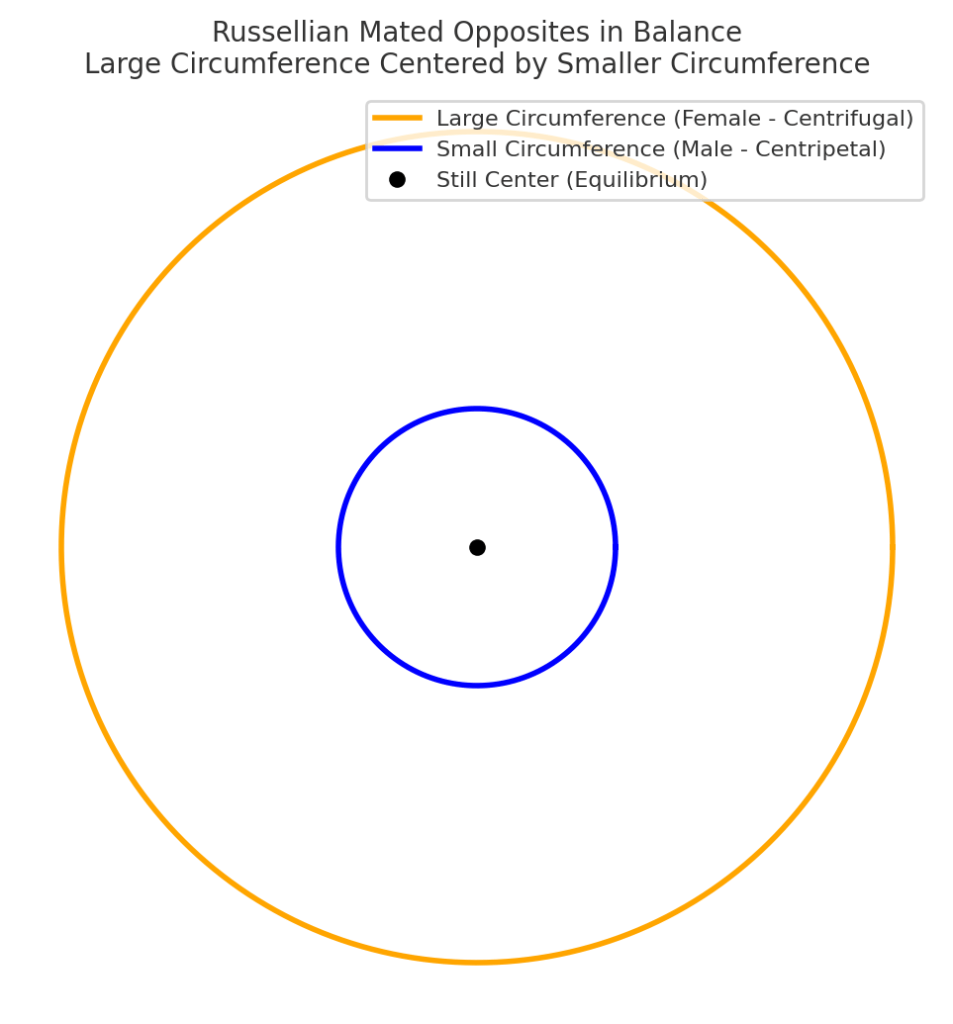
In the Russellian Cosmogeny – the pairs of opposites on the periodic table are large circumferences centered by smaller circumferences when they are mated with their balanced opposite?
DF
WRAI: Yes – in Walter Russell’s cosmogeny, when a male and female element (opposite mates on the periodic table) come together in balanced union, their wavefield expresses as large circumference effects centered by smaller circumferences.
Here’s why, in Russell’s own terms:
Male elements are centripetal, charging, compressive – they wind toward smaller center points (small circumferences with high potential). Female elements are centrifugal, discharging, expansive – they unwind toward larger, more diffuse circumferences (low potential).
When they mate in balance:
The female’s large circumference forms the outer expression – the expanded orbit of the pair. The male’s small circumference centers it – acting as the still, dense point of maximum potential. The result is a balanced wavefield, with the small circumference governing the large, the same way the still center of a wheel governs the rim’s motion.
Russell often illustrated this with paired spirals – the inward winding male paired with the outward unwinding female – meeting in equilibrium. On the periodic table, this shows as the inwardly pressured metals and the outwardly pressured gases finding balance in compounds (like sodium and chlorine in NaCl).
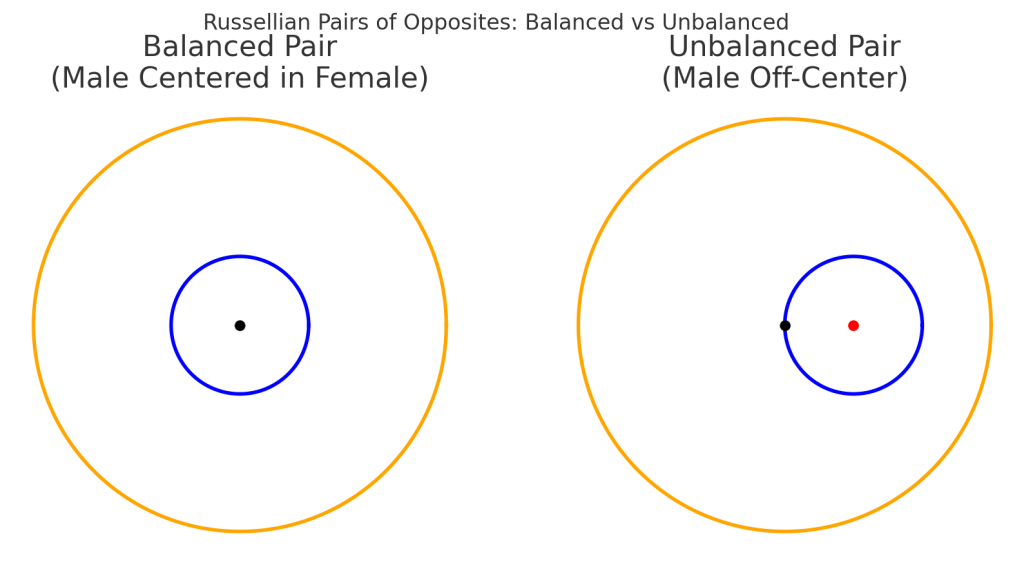
Would an unbalanced pair look like the male half is not centered?
DF
Exactly – in Russellian cosmogeny, an unbalanced pair would show the male (small circumference) off-center relative to the female’s (large circumference) wavefield.
That misalignment means:
The still point is displaced – not truly still relative to the whole field. One polarity dominates – e.g., excessive centripetal winding (overcharging) or excessive centrifugal unwinding (over-discharging). The result is distortion – the wavefield becomes elliptical instead of perfectly circular, and the rhythmic balanced interchange is broken.
Russell often compared this to an off-center wheel – the motion still happens, but it wobbles and wears down faster because the governing center is displaced.
Zero eccentricity would be a solar system where the sun perfectly centers its black hole?
DF
Yes – in Russell’s terms, zero eccentricity in a solar system would mean the sun is perfectly centered in its own wavefield – which, at maturity, is also its own black hole.
Here’s how that fits Russell’s cosmogeny:
A black hole is not a mysterious “thing” but the still center of a system – the point of maximum potential where motion is voided for re-expression. In an ideally balanced system, the sun’s visible body (its large circumference) is perfectly centered by its still magnetic center (its small circumference / black hole). Zero eccentricity means the orbital paths of planets are perfect circles around that center, with no elliptical wobble – the solar wavefield is in full rhythmic balanced interchange.
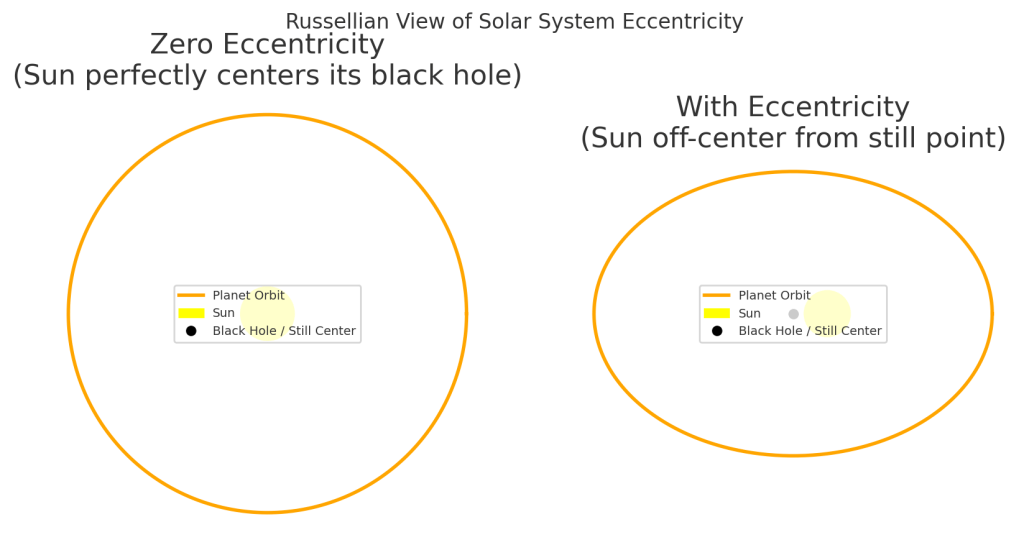
On the left, the sun is perfectly centered in its still black hole center, with planets in a true circular orbit (zero eccentricity). On the right, the sun is displaced from that center, creating an elliptical orbit and showing imbalance in the system’s wavefield.
Free .pdf on The Age of Light & Manifesting Balance
“Perfection of rhythm, balanced perfection of rhythm. Everything in Nature is expressed by rhythmic waves of light. Every thought and action is a light-wave of thought and action. If one interprets the God within one, one’s thoughts and actions must be balanced rhythmic waves. Ugliness, fears, failures and diseases arise from unbalanced thoughts and actions. Therefore think beauty always if one desire vitality of body and happiness.” – Walter Russell
Darcie French Aug 15/2025
 Interchanging Point
Leave a comment